How I Bring a Book into the World. Get yourself a hot drink or whatever … this will take a minute!
I sometimes get asked what it takes to write and publish a book. The short answer is: Quite a lot. The longer answer is that I don’t simply write a manuscript and hand it to somebody else.
I am a small publishing company, 9mm Press, and I have deliberately learnt how to do most of the process myself. That means I get to be the author, publisher, cover designer, formatter, marketer, production manager, occasional chief bottle washer, and tequila provider.
It is a lot of work.
It is also enormously satisfying.
And this is how I do it.
1. It starts with a breadcrumb
To date I have never begun with a carefully constructed plot.
Sometimes I get a title.
Sometimes I get a character.
Sometimes I get one scene.
Sometimes I notice something in real life that refuses to leave my head.
[Indigo Delta Kilo] began with a pair of Soviet-era cufflinks worn by a young father sitting in front of me and Doris at the ballet.That was the breadcrumb. The rest of the loaf came later. And apparently, after writing more than two dozen novels, I’ve learnt that my brain does quite a lot of the work when I give it room to wander.
That’s why I keep notebooks.
A strange thought gets written down.
A line of dialogue gets saved.
A title goes into a file.
A character says something interesting so in it goes.
I don’t necessarily know what any of it means yet.
I don’t have to.
The breadcrumbs have a way of forming an entire loaf if given enough space.
2. Then I write the bloody thing
Eventually there is enough of a story in my head that I have to start writing. This is the part where I disappear into the book. I write the first draft, follow the characters, discover things along the way and occasionally realise that the story I thought I was writing isn’t quite the story I’m actually writing. I know very little before I begin.
Sometimes I know the ending of a book that isn’t even a glimmer yet so it kinda hangs around my brain for however long it takes until I know where it sits.
Sometimes I know a handful of events – I see video of scenes, I rarely know where they sit in the story until I put my fingers on the keyboard and let it happen.
Sometimes I know one scene and a title.
The characters take over.
[Indigo Delta Kilo] was a particularly good example of that. I started it in late April. By July I was around 34,000 words. Up until then I was convinced I was slacking off and would never get the story out. Then something clicked. The story accelerated. I finished the first draft at more than 98,000 words on September 13th. I wrote 64,500 of those words in 51 days. Apparently my subconscious had been busy while I was pretending to be in charge.
3. Then comes the part where I have to stop pretending it’s perfect.
Finishing a first draft is wonderful.
It is also when I have to accept that I have written a first draft. I give it a few days to sink in and then the reading begins.
So I go back through it.
I look for things that don’t work.
Continuity problems.
Missing information.
Scenes that need more.
Scenes that need less.
Did I introduce everyone in a timely fashion for the new readers?
Characters who suddenly appear to have forgotten something they knew three chapters earlier or they know something that they shouldn’t, yet.
Timelines.
Names.
This is the point where I double check research but also allow myself permission to make shit up. Sometimes you have to. (With the Veronica Tracey Series … I have fudged a place to make it work better for me and handed a job to the Crown Prosecutor which probably wouldn’t be something they dealt with, but I did it because it made sense and I didn’t want to deal with legal teams from a bunch of ministries.)
And then there are all the little things that seemed perfectly sensible when I wrote them at midnight.
Then I get other eyes on it.
Beta readers are particularly useful to me because they read the book as readers, rather than as the person who has lived inside it for months and can only see it scene by scene.
For [Indigo Delta Kilo], one beta reader read the entire book in a day.
That was a very nice email to receive.
My second beta reader has a rather more specialised job: Professor of America™
Her task is essentially to make sure my Americans are sufficiently American.
Every book needs its own quality-control department.
Then there is editing. The only thing I really can’t do myself. Well, I can, but I know what I think it says not necessarily what it actually says. 😂
And then there is reading the book out loud to the cats or the dog. 😊
4. Then I turn the manuscript into a book.
This is where being independent gets particularly interesting.
I don’t send the manuscript off and wait for someone else to turn it into a product.
I’ve learnt how to format my own books.
I prepare the manuscript for the different editions.
I work on the print interior.
I create the eBook.
I check the front matter and back matter.
I deal with the ISBNs and order more if required.
I check the files.
I proof them.
And then I check them again. Proofs are ordered.
I have a specialised reader who goes over a physical proof word by word.
Because “it looked fine on my computer” is not an acceptable publishing quality-control system.
5. Then I make the cover.
This is one of my favourite parts. (Sometimes the cover shows itself in the first few chapters and I fiddle around with ideas then.). I’ve taught myself how to create my own covers for both print and eBook.
And I don’t just make one cover and call it done.
For [Indigo Delta Kilo], I created three versions and put them in front of people to vote.
The bright red and purple version won.
It needed to do several jobs at once:
Look like it belongs in the Veronica Tracey series.
Stand out in a thumbnail.
Tell the reader something about this particular story.
And, frankly, look bloody good.
The cover is the first thing most readers see.
So I take it seriously.
6. Then there is all the stuff people don’t think about.
There is a surprisingly large amount of book that isn’t the actual manuscript.
The blurb.
The synopsis.
Keywords.
Categories.
Metadata.
Author bio.
Series information.
Retailer descriptions.
Promotional graphics.
A+ content.
Social media posts.
Launch material.
Video trailers.
And all the other little pieces that help a book find its readers.I’ve learnt how to make those things myself too.That’s one of the great freedoms of running my own publishing company. If I have an idea, I don’t have to wait for somebody else’s production schedule.
I can just try it.
7. Then I publish it.
Once everything is ready, I upload the files, check the listings, check the metadata, check the pricing, check the editions…
And then eventually I press the button.
Publish. (Generally it is scheduled for a specific day in the future.)
There is something rather magical about that moment.
A few months earlier, the book existed only in my head. (It takes about a year from beginning to launch!)
Then it existed as a messy collection of words.
Then a manuscript.
Then a cover.
Then files.
And suddenly:
There it is.
A book.
That’s not the end.
I order author copies and check merch. Because there is a launch day to plan. I’ve been really lucky in that department, our city Library holds launches for me and it’s so much fun! It’s also work.
I’m a generous author & I love giving stuff away. I have my pens, notebooks, jig saw puzzles, reading blankets, drink bottles, bottle openers, bags … you get the idea. I make sure I have the merch ready well ahead of time.
8. Then I have to find readers.
This is the part where being an independent author becomes very real.
Writing the book doesn’t automatically mean people will find it.
I have to tell people it exists.
Sometimes that’s a launch. (It’s always a launch. They are stressful but ultimately fun.)
There is advertising.
There is social media.
There are promotions.
Sometimes a free-book promotion.
If I’m looking to shake things up I can experiment and see what happens.
And sometimes an older book surprises me.
Recently I made Written in Leaves, the first book in my Fates Entwined: The Spellbound Bookshop Trilogy, free for a few days. It went from nowhere on the rankings to #14, and then climbed to #6 in Australian & Oceanian Literature.
So naturally I thought: Well… let’s see what happens if I put Book Two into the promotion.
Because I can.
That’s the freedom I have.
9. And then the books start working for each other.
This is one of the things I love about having a backlist.
I don’t just have one book.
I have a catalogue.
Written in Leaves can lead to Scattered on Cloth.
Scattered on Cloth can lead to Drawn from Cards.
And there is crossover between the Fates Entwined books and the Veronica Tracey books and there is a crossover between the Veronica Tracey books and the FBI-Byte Series.
So a reader who discovers me through one book might eventually discover Ronnie. But I always hope they discover my FBI-Byte Series before the Veronica Tracey Spy/PI Series because of the spoiler potential if they hit Ronnie and the gang first.
That’s the long game.
I’m not simply trying to sell this book.
I’m trying to build a readership that enjoys my books.
10. And then I do it all again.
This is the slightly ridiculous part.
You might think that after publishing a book, I’d have a nice long rest. 😂
No.
There are always other ideas.
A title might appear.
A character might wander into my head.
A scene might demand to be written.
A breadcrumb might land.
And suddenly I’m making notes for another book.
In fact, while I’m still letting [Indigo Delta Kilo] breathe, [Bravo Romeo Bravo] has already appeared.
I have a title.
I have an opening chapter.
And I have absolutely no intention of pretending that means I have to write another 98,000-word novel tomorrow.
The idea can sit there.
It can breathe.
It can grow.
Or it can turn out to be nothing.
That’s okay too.
The bit that matters most to me.
I didn’t build 9mm Press because I wanted to make my life easier.
I built it because I wanted control over my work.
After years with a traditional publisher, I reached a point where I didn’t want somebody else holding the keys to my books.
So I learnt.
I learnt production.
I learnt covers.
I learnt formatting.
I learnt eBooks and print.
I learnt marketing.
I learnt all the fiddly things that happen between THE END and a reader holding the finished book.
And yes, sometimes it’s a lot
Things slide.
I’m only one person and there are only so many hours in a day.
But they don’t slide for long.
Because they’re my books.
And that makes a difference.
The deal I’ve made with myself is pretty simple: If I don’t work hard enough, I don’t sell books.
I know who is responsible.
I also know who gets to decide.
And when it works?
When I see a book I’ve written climbing a chart …
When somebody sends me a message saying they loved it …
When I hold the printed book in my hands …
When I look at a cover I designed myself …
When a little children’s book I made for my grandchildren arrives on their doorstep …
That’s satisfying.
Because I didn’t just write the book.
I brought it into the world.
And I get to do it again.
I’m not sure whether I became an independent publisher because I wanted to do everything myself, or whether I did everything myself until I realised I had become an independent publisher. Either way, I’m rather enjoying the view from here.
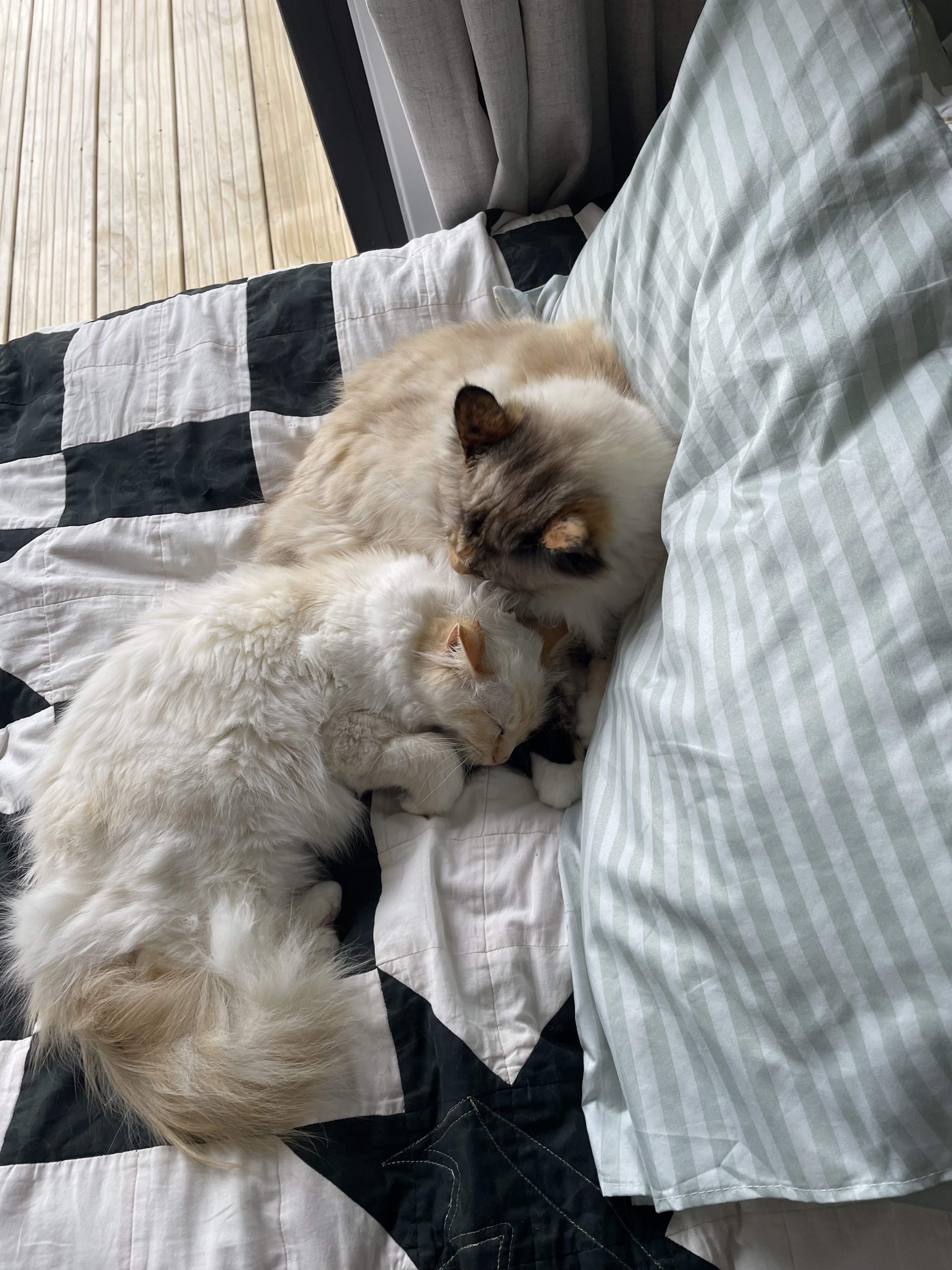
😂❤️ Here’s a couple of Birman: